
Over the past few years, the way we work has changed faster than any of us could have predicted. In a matter of months, office desks were replaced by kitchen counters, living‑room corners and improvised setups that became our new work reality. Remote work brought something many had longed for: freedom. Freedom to choose our rhythm, to skip the morning commute, to work in clothes that feel like us, to shape the day around our own energy.
But as flexibility grew, something else quietly faded.
A recent study published in Science reveals a side effect that’s becoming harder to ignore: working from home has increased isolation. People in remote‑friendly jobs now spend significantly more time alone than before the pandemic. For those living alone, the effect is even stronger — entire days passed without a single spontaneous conversation, without a glance across a desk, without that small, human “hey, how are you?” that means more than we admit.
Researchers link this rise in solitude to higher levels of mental distress — emotional fatigue, loneliness, dips in motivation, a sense of drifting through the day without structure.
The silence became too loud.
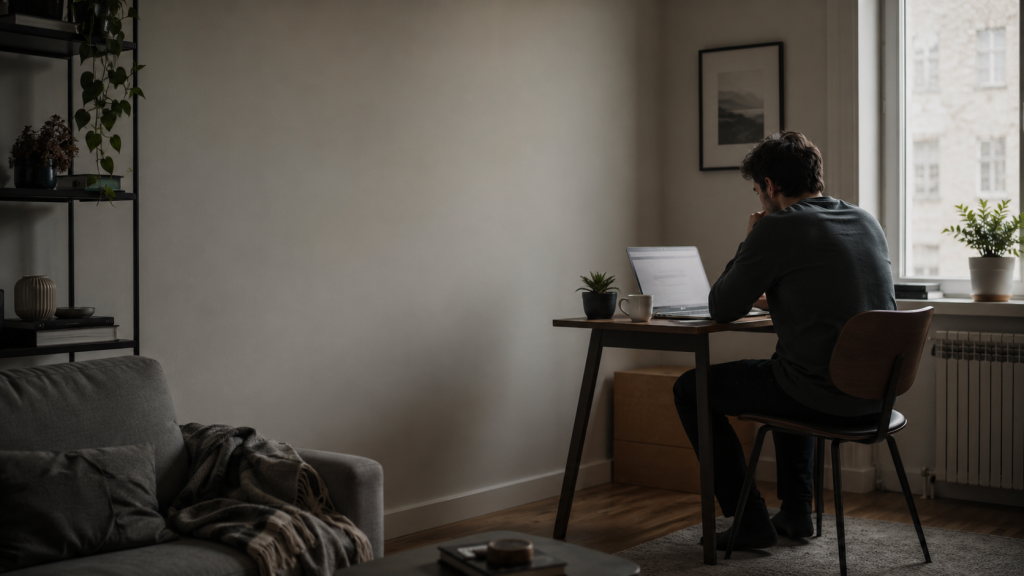
Work is more than tasks. Work is rhythm. Work is energy.
We often forget that work isn’t just the place where the laptop opens. Work is everything that happens around it.
It’s the energy we share with others. It’s belonging — the feeling of being part of something larger than our own screen. It’s the small human moments: the coffee break that resets your mind, the spontaneous chat that lifts your mood, the glance that says “I’m here too.”
This is why the answer isn’t a full return to the old office model. But it’s not endless solitude at the kitchen table either.
The future of work must be something in between: freedom with human connection.
This is where coworking steps in — spaces that bring people back to people
Coworking is not just a desk and a power outlet. It’s not “an office you rent.” Coworking is atmosphere.
It’s a place where you can retreat into silence when you need focus — but also feel the presence of others when you need motivation. It’s a space where you work independently, but never alone.
In good coworking spaces, there is something you can’t measure in square meters: rhythm.
A rhythm that pulls you out of the house. A rhythm that gives your day structure without taking away your freedom. A rhythm that creates a sense of belonging — even if you don’t know anyone’s name.
Coworking spaces are becoming a new kind of social fabric: small, everyday communities of people doing different jobs, sharing the same air, the same quiet, the same coffee break.
It’s what we miss when we work alone: the presence of others.
The most valuable places to work are no longer defined by size — but by feeling
There was a time when the value of a workspace was measured by the number of desks, the size of the office, the equipment. Today, it’s measured by something entirely different:
How often do people choose to return? How naturally does it bring people together? How much does it contribute to the rhythm of everyday life? How connected does it make us feel?
The best spaces aren’t the quietest, the trendiest or the most expensive. The best spaces are the ones where you feel good. The ones that give you energy. The ones that remind you that you’re not alone.
This is why flexible workspaces aren’t a trend — they’re a response to a new reality. They offer freedom, but also structure. Independence, but also community. Silence, but also warmth.
Where we work shapes how we work — and how we feel
It’s becoming clear: the future of work is neither fully remote nor fully office‑based. It is flexible, human, and connected.
Where we work has always shaped how we work. Now, more than ever, it shapes how connected we feel — to others, to ourselves, to our day.
And perhaps that’s what we’ve been missing most: not the office, not the home, but a space that brings us back to people.
A gentle guide for readers: how to feel more connected while working
Not as a list — but as a flow of ideas they can adopt:
Start the day with a ritual that signals “I’m beginning” — a walk, a coffee, a moment of planning. Choose at least one or two days a week to work outside your home — a coworking space, a library, a café. Let yourself have micro‑moments of connection: a short call, a shared lunch, a message to someone you care about. Create a small boundary between your work and your private world — even if it’s just a dedicated corner or a closing‑the‑laptop ritual. And above all, seek spaces that give you energy, not just convenience.
Because good work isn’t only about productivity. It’s about how we feel while doing it.